
Choose an AI assistant above to request a concise summary of this cursive-reading guide.
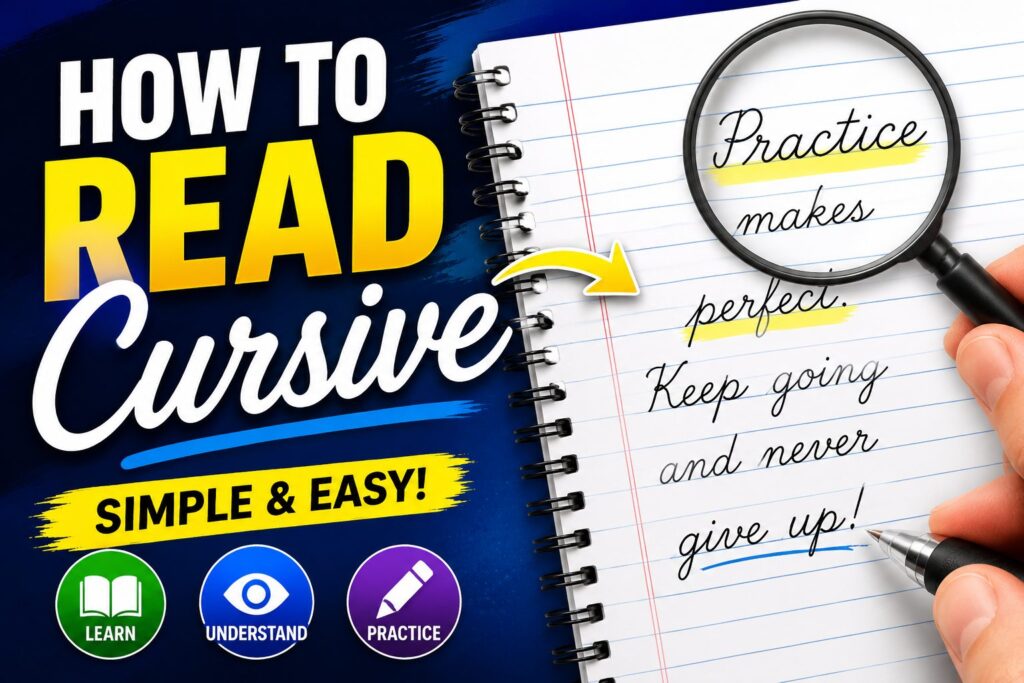
Cursive handwriting can look confusing when you first see it. Letters connect, familiar shapes appear different, and some words may seem like a single long line. However, once you understand the basic patterns, reading cursive becomes much easier.
Learning how to read cursive is useful for students, researchers, teachers, family historians, and anyone who needs to understand handwritten notes. It can help you read old letters, school assignments, greeting cards, signatures, journals, historical records, and personal documents.
You do not need beautiful handwriting or advanced language skills to read cursive. You only need to recognize common letter shapes, understand how connected letters change inside words, and practice reading complete words instead of examining every letter separately.
This guide explains how to read cursive step by step, recognize difficult letters, understand handwritten words from context, and improve your reading speed with regular practice.
What Is Cursive Writing?
Cursive writing is a handwriting style in which many letters are connected. Instead of lifting the pen after every letter, the writer moves smoothly from one letter to the next.
This creates a flowing appearance and often allows people to write more quickly.
In standard print handwriting, each letter usually stands separately:
The quick brown fox
In cursive handwriting, the letters may connect and appear more fluid. Some letters can also look different from their printed versions.
For example:
- A lowercase cursive “r” may look like a small upward curve.
- A lowercase cursive “s” may resemble a narrow loop.
- A cursive capital “G” may look very different from a printed “G.”
- The letters “m,” “n,” “u,” and “w” may look similar when written quickly.
Cursive styles also vary from person to person. Some writers follow traditional school-taught handwriting, while others use a personal mixture of cursive and print.
Why Is Cursive Difficult to Read?
Cursive can be difficult because the letters are not always clearly separated. The shape of one letter may blend into the next, making it hard to know where one character ends and another begins.
Several common factors make cursive challenging.
Connected Letters
The connecting strokes between letters can look like additional marks. A beginner may accidentally treat a connector as part of the previous or following letter.
Personal Handwriting Styles
Not everyone forms cursive letters in the same way. Writers often shorten loops, change letter heights, skip certain strokes, or combine cursive and printed letters.
Similar-Looking Letters
Several lowercase cursive letters can appear nearly identical, especially in fast handwriting.
Commonly confused groups include:
- “m,” “n,” “u,” and “w”
- “e,” “i,” and “l”
- “a,” “o,” and “d”
- “r,” “s,” and “v”
- “c” and “e”
- “g,” “q,” and “y”
Faded or Messy Writing
Old documents may contain faded ink, damaged paper, spelling variations, or writing that crosses page folds. Modern notes can also be difficult when written quickly.
Unfamiliar Capital Letters
Capital cursive letters are often more decorative than lowercase letters. A capital “F,” “Q,” “S,” or “T” may not immediately resemble its printed form.
The good news is that most cursive words become understandable when you focus on patterns, context, and repeated letter shapes.
How to Read Cursive Step by Step
Learning how to read cursive is easier when you use a consistent process. Instead of guessing every word immediately, break the task into smaller steps.
1. Study the Complete Cursive Alphabet
Start by becoming familiar with uppercase and lowercase cursive letters.
You do not need to memorize every decorative variation. Focus first on the most common school-style forms.
Pay special attention to lowercase letters because they appear most frequently in words.
Begin with easy letters such as:
- a
- c
- e
- i
- l
- o
- t
Then move to more difficult letters such as:
- b
- f
- k
- r
- s
- z
Finally, study commonly confused groups together.
For example, compare “m,” “n,” “u,” and “w” side by side. Notice the number of humps or downward strokes in each letter.
A cursive “n” normally has one main hump, while “m” often has two. A “u” may look like an “n,” but its entry and exit strokes can differ depending on the writer.
2. Look at the Shape of the Entire Word
One of the biggest mistakes beginners make is trying to identify every letter separately.
Cursive is designed to flow. Individual letters may be unclear, but the complete word shape often provides useful clues.
Look for:
- Tall letters
- Letters that drop below the line
- Dots above letters
- Crossed letters
- Loops
- The approximate word length
Tall lowercase letters may include:
- b
- d
- f
- h
- k
- l
- t
Letters that often extend below the writing line include:
- f
- g
- j
- p
- q
- y
- z
Suppose you are reading a five-letter word with a tall first letter and a final letter extending below the line. The surrounding sentence can help you determine which word fits that shape.
Reading by word shape is often faster and more accurate than decoding every stroke.
3. Identify the First and Last Letters
The first and last letters are usually easier to recognize because they are less crowded by connecting strokes.
Start by asking:
- What could the first letter be?
- What could the last letter be?
- How many letters appear to be in the word?
- Does the word fit the sentence?
For example, imagine the sentence:
“She placed the flowers on the _____.”
If the handwritten word begins with “t” and ends with “e,” you might consider “table.”
Context limits the possible answers, even when the middle letters are unclear.
4. Find Dots and Crossed Strokes
Dots and horizontal lines are valuable reading clues.
A dot may indicate:
- i
- j
A crossed stroke may indicate:
- t
- sometimes f, depending on the style
However, writers do not always place dots or crosses directly above the correct letter. A person writing quickly may add all dots and crossbars after finishing the word.
This means a dot may appear slightly to the left or right of the letter it belongs to.
Do not reject a possible word simply because the dot placement is imperfect.
5. Compare Repeated Letters
When reading a paragraph, letter repetition can help you understand the writer’s personal style.
Suppose you recognize the word “the” in one sentence. Study how the writer forms the letters “t,” “h,” and “e.” You can use those shapes to identify the same letters elsewhere.
Common words are especially useful as references:
- the
- and
- is
- was
- with
- from
- this
- that
- have
- you
Once you identify a writer’s version of a letter, reading the rest of the page often becomes easier.
6. Use Sentence Context
Context is one of the most powerful tools for reading difficult handwriting.
Read the words before and after the unclear section. Consider the grammar, subject, and likely meaning of the sentence.
For example:
“I will meet you at the train _____.”
Possible words may include:
- station
- platform
- terminal
The visible letter shapes can then help you choose the most likely answer.
Context should guide your interpretation, but it should not replace visual evidence. Avoid forcing a word into the sentence when the letter shapes do not support it.
A good approach is to make a temporary guess, continue reading, and return to the unclear word later.
7. Separate the Word into Letter Groups
Long cursive words can be easier to read when divided into smaller sections.
Instead of reading:
understanding
as one continuous shape, divide it mentally:
under + stand + ing
Look for familiar prefixes, suffixes, and word endings such as:
- un-
- re-
- pre-
- dis-
- -ing
- -ed
- -ly
- -tion
- -ment
- -able
Recognizing common word parts reduces the number of letters you need to decode individually.
8. Trace the Stroke Direction Mentally
When a letter is unclear, imagine how the pen may have moved.
Ask:
- Did the stroke begin on the writing line?
- Did it rise into a tall loop?
- Did it drop below the line?
- Did the pen return to connect with the next letter?
Understanding how cursive letters are formed can help you identify confusing shapes.
You can also trace the word lightly with your finger on the screen or paper. Following the movement of the strokes may reveal where letters begin and end.
9. Read the Passage More Than Once
Do not expect to understand every word during the first reading.
Use a multi-pass approach.
During the first pass, read the easy words and identify the general topic.
During the second pass, focus on unclear words using context.
During the third pass, compare repeated letters and check whether your guesses make sense.
A word that seems impossible at first may become obvious after you understand the rest of the sentence.
How to Recognize Difficult Cursive Letters
Certain cursive letters regularly cause problems for beginners.
Cursive M, N, U, and W
These letters are often confused because they contain similar humps.
Count the repeated upward and downward movements, but remember that connecting strokes may make the number of humps unclear.
Use the surrounding letters and sentence meaning to confirm your choice.
Cursive R
A lowercase cursive “r” does not always look like a printed “r.” It may appear as a small upward point, curve, or narrow shoulder.
Words such as “are,” “right,” and “from” can help you learn common variations.
Cursive S
The lowercase cursive “s” may look like a small loop, hook, or pointed shape. Some writers use a form that resembles a printed “s,” while others use a more traditional cursive shape.
Cursive F
Both uppercase and lowercase cursive “f” can be difficult. The lowercase version may have a tall loop and a lower loop that extends below the line.
In some writing styles, it resembles a long narrow figure-eight.
Cursive Capital Letters
Capital cursive letters often contain extra loops and decorative strokes. Instead of trying to memorize every possible design, examine the rest of the word.
If a sentence says:
“Dear _____,”
the capital letter likely begins a person’s name.
The remaining lowercase letters may provide enough information to identify it.
How to Read Messy Cursive Handwriting
Messy cursive requires patience, but the same basic techniques still apply.
First, enlarge the writing when possible. A high-resolution photograph or scan can make faint strokes easier to see.
Next, improve the visual contrast. Increasing brightness or contrast may help separate faded ink from the paper.
Then look for repeated words and letters. Even messy writers tend to form the same letter in a similar way throughout a document.
You should also consider the type of document.
A shopping list will contain different vocabulary from a legal record, school essay, personal letter, or medical note. Knowing the document type helps narrow the possible words.
When one word remains unreadable, mark it with a question mark and continue. Spending too long on one word may prevent you from understanding the larger message.
How to Read Old Cursive Documents
Historical cursive can be more difficult because older documents may use unfamiliar spelling, vocabulary, abbreviations, and handwriting systems.
Begin by identifying basic details:
- The approximate date
- The language
- The document type
- The writer’s location
- The names mentioned
- Repeated phrases
Old records often use predictable structures.
Birth, marriage, census, church, military, and legal documents may repeat the same headings and sentence patterns. Once you understand one section, you can use it as a guide for the rest.
Be aware that spelling was not always standardized. A name may appear in multiple forms within the same collection of records.
Writers also used abbreviations that are uncommon today. Keep a list of repeated symbols or shortened words and compare them across the document.
Useful Practice Methods for Reading Cursive
Regular practice is more effective than trying to memorize the entire alphabet in one session.
Start With Clear Handwriting
Begin with carefully written cursive rather than old or highly personal handwriting.
Children’s handwriting worksheets, school examples, and clearly written notes are useful for learning standard letter shapes.
Practice With Short Sentences
Read short sentences before moving to long paragraphs.
Examples might include:
- Today is a beautiful day.
- Please remember to call me.
- We are going to the park.
- Thank you for your help.
Short sentences make it easier to use context without feeling overwhelmed.
Compare Print and Cursive Versions
Place a printed sentence beside its cursive version. Compare each word and notice how the letter connections affect the overall appearance.
After reviewing the pair, cover the printed sentence and try reading the cursive version independently.
Write Cursive Yourself
Writing cursive can improve your reading ability because you begin to understand how the strokes connect.
You do not need perfect handwriting. Simply practice forming basic letters and common words.
When you know how a letter is created, you are more likely to recognize it in someone else’s handwriting.
Read a Little Every Day
Ten minutes of daily practice can be more helpful than one long session each month.
Use handwritten cards, notes, scanned letters, worksheets, or digital samples. Try to read the text before checking a transcription.
Use a Cursive Reading Tool
A cursive reading tool can help when handwriting is unclear or when you need a starting point for transcription.
You can upload or examine a handwritten image and compare the suggested text with the original writing.
However, automated results may not always be perfect. Image quality, unusual letter shapes, shadows, page folds, and decorative handwriting can affect accuracy.
Use digital tools as reading assistants rather than treating every result as final.
Common Mistakes to Avoid
Several habits can slow down your progress.
Guessing Without Checking the Shapes
Context is helpful, but the visible strokes should still match the word you choose.
Focusing on One Letter for Too Long
Move to the next word and return later. The rest of the sentence may reveal the answer.
Expecting Every Writer to Use Standard Cursive
Real handwriting often includes personal variations, shortcuts, and mixed print-cursive forms.
Ignoring Spacing
Some writers leave very little space between words. Look for longer pen lifts or changes in stroke position to identify word boundaries.
Reading Too Quickly
Slow down when learning. Accuracy matters more than speed at the beginning.
How Long Does It Take to Learn to Read Cursive?
The learning time depends on your starting ability, practice frequency, and the handwriting style you are trying to read.
Many beginners can recognize basic cursive letters after a few focused practice sessions. Reading clear sentences may become comfortable within several weeks of regular practice.
Old, decorative, or messy handwriting usually takes longer.
Progress is rarely equal across every letter. You may quickly recognize common words while still struggling with certain capital letters or personal handwriting styles.
The best way to improve is to practice with several writers rather than reading only one handwriting sample.
Tips for Reading Cursive Faster
Once you can recognize most letters, focus on reading fluency.
Try these methods:
- Read complete phrases instead of isolated letters.
- Memorize the shapes of common words.
- Use the subject of the passage to predict vocabulary.
- Compare repeated letter combinations.
- Practice with timed reading sessions.
- Review mistakes after completing the passage.
- Read different handwriting styles.
Speed will improve naturally as word shapes become familiar.
Do not sacrifice accuracy just to finish quickly. A careful reader who understands the sentence is more effective than a fast reader who guesses incorrectly.
Frequently Asked Questions
Is Cursive Hard to Read?
Cursive may feel difficult at first because the letters connect and some shapes differ from printed writing. It becomes easier when you learn common letter patterns, examine complete word shapes, and use sentence context.
Can I Learn to Read Cursive Without Writing It?
Yes. You can learn by studying cursive alphabets, reading sample words, and comparing handwritten text with printed transcriptions. However, practicing basic cursive writing may help you understand how the strokes are formed.
What Cursive Letters Are Most Difficult to Read?
The most commonly confused lowercase letters include “m,” “n,” “u,” “w,” “r,” “s,” and “e.” Decorative capital letters such as “F,” “G,” “Q,” “S,” and “T” may also require extra practice.
How Can I Read Old Family Letters?
Start by scanning or photographing the letters clearly. Identify repeated names, dates, greetings, and common words. Read the easiest sections first, compare repeated letter shapes, and use the topic of the letter to interpret unclear words.
Can Technology Read Cursive Handwriting?
Some handwriting recognition tools can identify cursive text from images, especially when the writing is clear and the image quality is good. Results may be less accurate with faded ink, overlapping strokes, decorative writing, or damaged documents, so manual review is still important.
Final Thoughts
Learning how to read cursive is mainly a matter of pattern recognition and practice. You do not need to identify every letter perfectly during your first attempt.
Begin with the alphabet, study commonly confused letters, and focus on complete word shapes. Use first and last letters, dots, crossbars, tall strokes, lower loops, and sentence context as clues.
When handwriting is difficult, read the surrounding text, compare repeated letter forms, and return to unclear words after understanding the larger passage.
With regular practice, connected letters will stop looking like random loops and begin to look like familiar words. Whether you are reading a handwritten note, an old family letter, a school document, or a historical record, the process becomes easier each time you practice.

Comments
0 responsesNo comments yet. Be the first to share your thoughts.